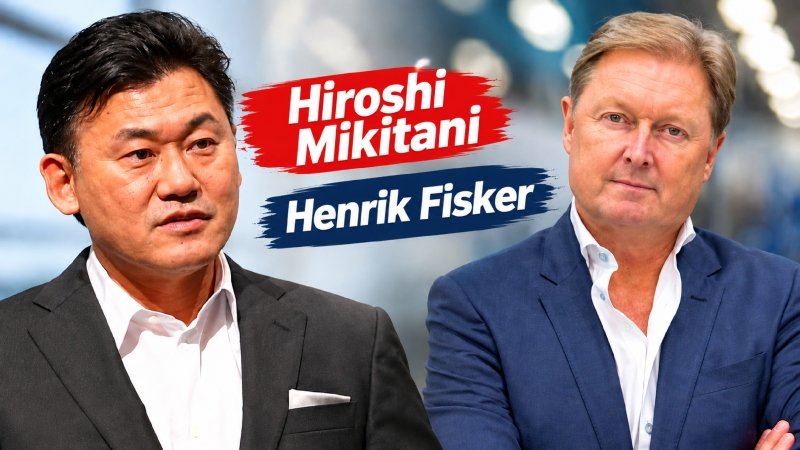
When people search for Hiroshi Mikitani and Henrik Fisker, they may expect to find a shared company, partnership, or family connection. Publicly available corporate and biographical records do not establish a major direct relationship between the two. Instead, the connection is more interesting: both built careers around innovation, entrepreneurship, technology, and global ambition, but they approached those goals from very different industries.
Mikitani built Rakuten into a broad internet-services ecosystem spanning e-commerce, fintech, communications, digital content, and other businesses. Fisker built his reputation through automotive design and later founded companies focused on premium and electric vehicles. Their stories show two distinct approaches to turning an idea into a global business.
Quick Facts
| Detail | Hiroshi Mikitani | Henrik Fisker |
|---|---|---|
| Born | March 11, 1965 | August 10, 1963 |
| Birthplace | Kobe, Japan | Allerød, Denmark |
| Nationality | Japanese | Danish |
| Education | Hitotsubashi University; Harvard Business School | ArtCenter College of Design |
| Main field | Technology, e-commerce, fintech | Automotive design, mobility, EVs |
| Best known for | Founding Rakuten | Designing major luxury cars and founding Fisker companies |
| Major companies | Rakuten, Crimson Group | Fisker Automotive, Fisker Inc., HF Design |
| 2026 status | Chairman, President and CEO of Rakuten Group | Automotive designer and entrepreneur; Fisker Inc. entered bankruptcy proceedings in 2024 |
Rakuten’s official 2026 management information identifies Mikitani as Representative Director, Chairman, President and CEO.
Early Life and Education
Hiroshi Mikitani
Hiroshi Mikitani was born in Kobe, Japan, on March 11, 1965. He attended Hitotsubashi University and later earned an MBA from Harvard Business School in 1993. His early professional career began at the Industrial Bank of Japan in 1988.
His experience at Harvard became particularly important to his entrepreneurial outlook. Mikitani has explained through Rakuten that studying in the United States changed his understanding of entrepreneurship and encouraged him to consider building a company rather than following a conventional corporate career.
The 1995 Kobe earthquake also became a major turning point. In an interview preserved by Harvard Business School Alumni, Mikitani described the destruction of his hometown as an important reason for wanting to contribute to Japan’s economic revitalization.
Henrik Fisker
Henrik Fisker was born on August 10, 1963, in Allerød, Denmark. His interest in automobiles developed early, eventually leading him toward professional transportation and automotive design.
He studied automotive design at the ArtCenter College of Design. His formal design training became the foundation for a career that would take him through BMW, Ford, Aston Martin, and eventually his own automotive ventures. SEC filings describe his Bachelor of Science in Automotive Design and document his senior roles across the automotive industry.
Personal Life
Mikitani married Haruko Mikitani in 1993, and publicly available biographical sources report that they have two children. His wife was also involved in the early development of Rakuten’s operations.
Fisker is married to Dr. Geeta Gupta-Fisker. The couple co-founded the modern Fisker business, with Gupta-Fisker serving in senior financial and operating roles. SEC records identify their marital and professional relationship.
Both entrepreneurs have maintained professional lives that extend beyond a single company. Mikitani has held leadership positions connected with sports, culture, telecommunications, and healthcare technology, while Fisker’s career has repeatedly returned to automotive design and product development.
Career and Business Journey
Mikitani’s Rise With Rakuten
After leaving banking, Mikitani established Crimson Group and then founded Rakuten in February 1997. Rakuten Ichiba, the company’s online marketplace, launched in May of the same year. Rakuten later went public in 2000.
What began as an online shopping marketplace became something much larger. Rakuten expanded into travel, digital content, banking, securities, credit cards, payments, communications, and mobile services. Rakuten currently describes its ecosystem as containing more than 70 businesses.
Mikitani’s major strategic idea was not simply to build an online store. He developed an ecosystem in which customers and businesses could interact across multiple services. That approach helped define his career as a platform and ecosystem builder rather than simply an e-commerce executive.
Rakuten’s corporate information lists 29,419 consolidated employees as of December 31, 2025. In 2026, the company continued to reorganize parts of its fintech operations, showing that Mikitani’s leadership remains connected to major strategic decisions at the group.
Fisker’s Automotive Design Career
Fisker’s career followed a completely different route. He worked at BMW during the late 1990s and became associated with the design development that led to the BMW Z8. He later joined Aston Martin, where he became Design Director and worked on vehicles including the Aston Martin DB9 and V8 Vantage. SEC records document these major stages of his professional history.
In 2005, Fisker moved further into entrepreneurship through Fisker Coachbuild. In 2007, he co-founded Fisker Automotive. The company developed the Fisker Karma, a luxury plug-in hybrid that became one of the early high-profile attempts to combine premium automotive design with electrification.
Fisker Automotive eventually encountered severe financial and production difficulties and entered Chapter 11 bankruptcy in 2013 after Fisker had left its executive chairman position.
Fisker later returned to the electric-vehicle market. He co-founded Fisker Inc. in 2016 with Geeta Gupta-Fisker. The company developed the Fisker Ocean electric SUV and pursued an asset-light automotive model involving outside manufacturing and technology partnerships.
That second venture also faced major financial and operational challenges. Fisker’s U.S. entities filed for Chapter 11 protection in June 2024. Reuters reported estimated assets of $500 million to $1 billion against liabilities of $1 billion to $10 billion at the time of the filing.
Major Achievements
Mikitani’s most significant achievement is the creation and expansion of Rakuten. From a small Japanese internet venture, he developed a diversified international business group. His honors include the Harvard Business School Alumni Achievement Award and France’s Legion of Honour.
His influence also reaches beyond commerce. Rakuten has expanded into mobile communications, fintech, sports, entertainment, and healthcare technology, giving Mikitani a broad footprint across multiple industries.
Fisker’s greatest professional achievement remains his influence on automotive design. The BMW Z8, Aston Martin DB9, and V8 Vantage are among the vehicles associated with his design career. His later companies also placed electric vehicles and sustainability at the center of their product strategies.
Hiroshi Mikitani and Henrik Fisker: What Connects Them?
There is no well-established public evidence of a major partnership, family relationship, or shared company connecting the two entrepreneurs.
Their relevance together comes from comparison. Mikitani demonstrates how an entrepreneur can build value through platforms, services, partnerships, and an interconnected business ecosystem. Fisker demonstrates how design expertise can become the foundation for product companies and ambitious automotive ventures.
| Area | Hiroshi Mikitani | Henrik Fisker |
|---|---|---|
| Core expertise | Digital business and corporate strategy | Automotive design and product vision |
| Signature creation | Rakuten ecosystem | High-profile automobiles and EV ventures |
| Industry | Internet services and fintech | Automotive and electric mobility |
| Entrepreneurial model | Diversification and ecosystem expansion | Design-led product innovation |
| Major challenge | Managing a highly diversified global group | Financing, production, and scaling vehicle companies |
The comparison is useful because it shows that innovation does not follow one formula. One entrepreneur built an interconnected service ecosystem; the other repeatedly attempted to turn automotive design into scalable products.
Net Worth 2026
Reliable 2026 net-worth figures for both men are difficult to establish from primary sources, and private assets, shareholdings, liabilities, and market movements can change valuations considerably.
Mikitani is widely described by financial publications as a billionaire, with much of his wealth historically linked to his ownership and interests in Rakuten and related holdings. However, a precise 2026 figure should be treated as an estimate rather than a confirmed personal financial statement.
Fisker’s current personal net worth is even harder to verify. His entrepreneurial companies have experienced substantial financial changes, including the 2024 Fisker Inc. bankruptcy proceedings. Therefore, specific online dollar figures should not be presented as confirmed 2026 wealth without a strong, current source.
For readers researching celebrity or executive wealth, the distinction between an estimated net worth and verified financial disclosure is essential.
Income Sources
Mikitani’s economic interests are primarily connected with his executive leadership, ownership and investment interests, and the broader Rakuten ecosystem. Rakuten’s official corporate disclosures show that he remains a major shareholder and the group’s chairman and CEO.
Fisker’s professional income has historically come from executive leadership, design work, entrepreneurship, and ownership interests in businesses connected with automotive development. His compensation and equity arrangements at Fisker Inc. were documented in SEC filings, although those historical figures should not be interpreted as his current 2026 income.
Lifestyle and Physical Stats
Both entrepreneurs maintain relatively private personal lives compared with entertainment celebrities. Mikitani’s public profile is strongly associated with business, technology, sports, culture, and philanthropy. Fisker’s public identity centers heavily on automotive design, mobility, and entrepreneurship.
Physical statistics deserve caution. Mikitani’s height and other body measurements are not reliably documented in major primary sources, so specific numbers should not be treated as verified facts. Fisker is frequently listed online at approximately 6 feet 3 inches, but this measurement is not consistently documented by authoritative corporate sources. For that reason, readers should regard such figures as unverified rather than definitive.
Future Prospects in 2026
Mikitani’s future remains closely tied to Rakuten’s continued evolution. The company is pursuing changes to its fintech structure and continues operating across internet services, mobile, and financial businesses. Rakuten announced in 2026 that it expected its fintech reorganization to take effect in October 2026, subject to required approvals and other conditions.
Fisker’s future is less directly tied to the former Fisker Inc. operating structure following its bankruptcy proceedings. His established expertise in automotive design remains the central asset of his professional identity, but claims about specific future ventures should be treated cautiously unless supported by new authoritative announcements.
Key Takeaways
The central lesson from these two careers is that innovation can take radically different forms. Mikitani used technology, entrepreneurship, and business integration to build an extensive corporate ecosystem. Fisker used design, branding, and automotive engineering to pursue new vehicle concepts.
Their careers also demonstrate that innovation and business success are not identical concepts. A strong product idea can face financing and manufacturing problems, while a successful platform must continually adapt as markets and technologies change.
Frequently Asked Questions
Are Hiroshi Mikitani and Henrik Fisker related?
No major family relationship between the two has been established in reliable public biographical or corporate records.
What is Hiroshi Mikitani best known for?
He is best known as the founder and longtime leader of Rakuten, which grew from an online marketplace into a diversified global internet-services group. Rakuten’s 2026 management information lists him as Chairman, President and CEO.
What cars did Henrik Fisker design?
His professional design credits include the BMW Z8 and major Aston Martin models such as the DB9 and V8 Vantage.
What happened to Fisker Inc.?
Fisker Inc. and related U.S. entities entered Chapter 11 bankruptcy proceedings in June 2024 after facing serious financial and operational difficulties.
Is Hiroshi Mikitani still leading Rakuten in 2026?
Yes. Rakuten’s official management information dated April 1, 2026 lists Mikitani as Representative Director, Chairman, President and CEO.
Why are these two entrepreneurs compared?
They are compared because both represent high-profile approaches to innovation and entrepreneurship, but their careers developed in very different fields. Mikitani built a technology and services ecosystem, while Fisker built his reputation around automotive design and electric-mobility ventures.
Conclusion
The story behind Hiroshi Mikitani and Henrik Fisker is not primarily about a hidden partnership or shared corporate history. It is about two entrepreneurs who pursued innovation from opposite sides of the business world.
Mikitani transformed a Japanese e-commerce startup into the broad Rakuten ecosystem and continues to lead the company in 2026. Fisker established himself as an influential automotive designer before turning his design reputation into entrepreneurial ventures focused on electrified vehicles.
Their careers offer a useful reminder for readers and business professionals: innovation can begin with a marketplace, a technology platform, a vehicle design, or a completely new business model. What happens afterward depends on execution, capital, leadership, timing, and the ability to adapt when the market changes. For more info to visit my Site.