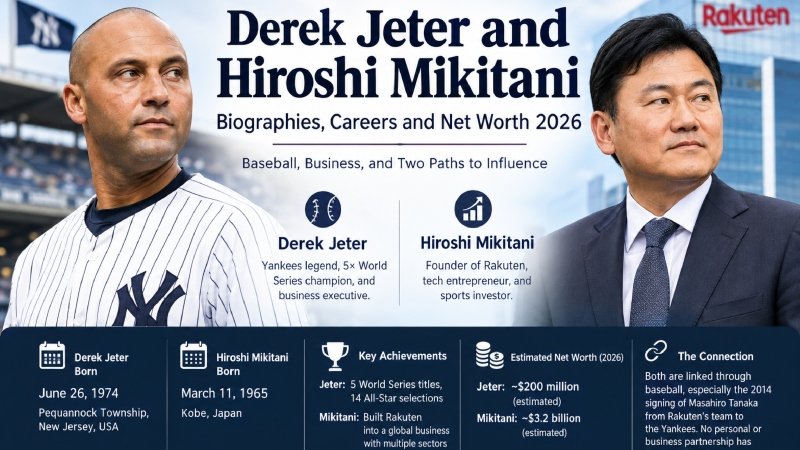
Derek Jeter and Hiroshi Mikitani built their reputations in different worlds, but professional baseball provides a compelling link between their stories. Jeter became a legendary New York Yankees shortstop, while Mikitani founded Rakuten, a Japanese technology company that expanded into e-commerce, financial services, telecommunications, and professional sports.
Their connection becomes clearer through Masahiro Tanaka, the Japanese pitching star who helped the Tohoku Rakuten Golden Eagles win their first Japan Series championship before signing with the Yankees in 2014. Jeter was New York’s captain when Tanaka arrived, while Mikitani was Rakuten’s founder and the owner associated with the Japanese club.
The important distinction is that an indirect professional connection does not prove a personal relationship. Publicly documented records establish the baseball connection, but the sources reviewed do not establish that Jeter and Mikitani were close friends, direct business partners, or involved in a joint venture.
Understanding their stories means looking beyond their names to the baseball transaction, business decisions, and leadership experiences that brought their professional worlds into the same conversation.
Who Are Derek Jeter and Hiroshi Mikitani?
Derek Jeter is an American baseball legend whose entire Major League career was spent with the New York Yankees. Hiroshi Mikitani, also known as Mickey Mikitani, is a Japanese entrepreneur who founded Rakuten in 1997 and became a prominent figure in international business and professional sports.
Their backgrounds differ considerably, but both became influential beyond their original roles. Jeter moved from championship baseball into sports management and media, while Mikitani expanded his technology business into sports ownership and other industries.
| Detail | Derek Jeter | Hiroshi Mikitani |
|---|---|---|
| Nationality | American | Japanese |
| Born | June 26, 1974 | March 11, 1965 |
| Main field | Professional baseball | Entrepreneurship and technology |
| Best known for | New York Yankees career | Founding Rakuten |
| Baseball involvement | Former Yankees captain and player | Founder and leader of Rakuten; owner associated with the Golden Eagles |
| Major achievement | Five World Series championships | Building Rakuten into a major internet-services group |
| Broader influence | Sports media and team management | E-commerce, fintech, telecommunications, and sports |
These differences are essential to understanding the keyword. The story is not about two men who achieved success in the same profession. It is about how separate careers intersected through international baseball.
Derek Jeter: From Yankees Rookie to Baseball Icon
Derek Sanderson Jeter was born on June 26, 1974, in Pequannock, New Jersey, and grew up in Kalamazoo, Michigan. His passion for baseball developed early, and his talent eventually attracted the attention of professional scouts.
The New York Yankees selected Jeter sixth overall in the 1992 MLB Draft. After progressing through the minor leagues, he made his major league debut on May 29, 1995, and secured the starting shortstop position the following season.
His impact was immediate. Jeter won the American League Rookie of the Year award in 1996 and helped the Yankees capture their first World Series championship since 1978.
More championships followed in 1998, 1999, and 2000. The Yankees won another title in 2009, giving Jeter five World Series championships during his playing career.
His achievements extended beyond team success. He earned 14 All-Star selections, five Gold Glove Awards, and the 2000 World Series Most Valuable Player award. He finished his career with 3,465 regular-season hits and a .310 batting average.
In 2003, the Yankees named Jeter captain, recognizing his leadership and importance to the franchise. He retired after the 2014 season and was elected to the National Baseball Hall of Fame in 2020, receiving 396 of 397 votes.
These accomplishments explain why Jeter remains one of the most recognizable figures in baseball. His career was defined by sustained performance, championship experience, and a long association with one of the sport’s most famous teams.
Jeter Career After Retirement
Jeter continued working in sports and media after leaving the field. In 2014, he launched The Players’ Tribune, a platform that allows athletes to share personal stories and perspectives directly with readers.
In 2017, he became a part owner and chief executive officer of the Miami Marlins. The position gave him experience managing a professional baseball organization rather than competing as a player.
His time with the Marlins ended in 2022, when he announced his departure and relinquished his ownership interest. Jeter post-playing career demonstrates that his influence extends beyond his statistics. He has pursued opportunities in publishing, sports management, and broadcasting, building a professional identity separate from his playing achievements.
Hiroshi Mikitani: The Entrepreneur Behind Rakuten
Hiroshi Mikitani was born on March 11, 1965, in Kobe, Japan. He studied at Hitotsubashi University before beginning his career at the Industrial Bank of Japan in 1988.
He later earned an MBA from Harvard Business School in 1993. His background in finance provided a foundation for the entrepreneurial career that followed.
The devastating Kobe earthquake in January 1995 became a major turning point in his life. The disaster contributed to his reassessment of his professional priorities and strengthened his determination to pursue entrepreneurship.
In February 1997, Mikitani founded the company that became Rakuten. Its original business model centered on an online marketplace where merchants could establish their own stores and connect directly with customers.
Rather than relying exclusively on selling products itself, Rakuten developed a platform that supported a broad network of merchants. This approach helped the company expand into a much larger digital-services ecosystem.
Over time, Rakuten entered areas including travel, banking, credit cards, digital content, and mobile communications. Its growth established Mikitani as one of Japan’s most prominent technology entrepreneurs.
Another notable decision came in 2010, when he introduced English as Rakuten’s internal corporate language. The initiative, often called Englishnization, was designed to make international communication easier and support the company’s global ambitions. Mikitani’s business interests eventually extended into professional sports, creating the connection most relevant to this keyword.
How Hiroshi Mikitani Became Involved in Baseball
In 2004, Rakuten entered Japanese professional baseball through the establishment of the Tohoku Rakuten Golden Eagles. The club began competing in Nippon Professional Baseball in 2005 and became an important part of the company’s presence in Japanese sports.
Mikitani’s involvement represented a different path into baseball from Jeter’s. Jeter built his reputation by playing the game at the highest level, while Mikitani approached it through business leadership and team ownership.
The Golden Eagles reached a major milestone in 2013 when they won their first Japan Series championship. Their success was especially meaningful for the Tohoku region, which had suffered the devastating earthquake and tsunami of 2011.
One of the central figures in that championship season was Masahiro Tanaka. His outstanding pitching performances helped propel the team to the title and established him as one of the most sought-after players in international baseball. Tanaka’s success created an opportunity that would bring Rakuten’s baseball organization into the story of the New York Yankees.
Masahiro Tanaka: The Link Between Jeter and Mikitani
Masahiro Tanaka provides the clearest documented professional connection between Derek Jeter and Hiroshi Mikitani. Tanaka joined the Rakuten Golden Eagles in 2007 and spent seven seasons with the club. His final season in Japan was exceptional: in 2013, he recorded a 24–0 regular-season record with a 1.27 earned run average.
Those results helped the Golden Eagles win their first Japan Series championship and made Tanaka a major target for MLB teams. On January 22, 2014, the New York Yankees announced that they had signed Tanaka to a seven-year Major League contract. The deal was worth $155 million, and the Yankees also paid Rakuten a separate $20 million posting fee under the international transfer system in effect at the time.
The move linked two baseball organizations associated with Jeter and Mikitani. Jeter was the Yankees captain during Tanaka’s arrival. Mikitani was Rakuten’s founder and the owner associated with the team from which Tanaka departed.
Their connection is therefore grounded in a real sporting event rather than an assumed friendship or business relationship. The signing also illustrated the growing international reach of professional baseball. A Japanese player who had helped deliver a historic championship for his home club was moving to one of the most prominent franchises in American sports.
For the Yankees, Tanaka represented a major investment in their pitching rotation. For Rakuten, the transaction marked the departure of a championship-winning player while providing a posting fee under the rules governing his move.
Jeter, the timing was particularly significant. Tanaka joined the Yankees during Jeter’s final major league season, making 2014 a meeting point between the veteran captain’s career and the arrival of an international pitching star. The transaction is the strongest factual basis for explaining why people search for Derek Jeter and Hiroshi Mikitani together.
Did Derek Jeter and Hiroshi Mikitani Ever Work Together?
- This question deserves a direct answer because the existence of an indirect connection can easily be exaggerated online.
- Jeter and Mikitani held different roles within the baseball world. Jeter was a Yankees player and captain, while Mikitani was a business executive and team owner associated with Rakuten’s baseball organization.
- Tanaka’s move created a connection between their professional environments, but it does not independently demonstrate that the two men worked together directly.
- The sources reviewed for this article do not establish a joint business venture, shared investment, or personal friendship between them. Nor does the transfer alone prove that they negotiated with each other.
- A claim of direct collaboration would require additional evidence, such as a documented meeting, an official announcement, a joint project, or a credible interview confirming their involvement.
- Until such evidence is available, the most accurate description is that Jeter and Mikitani are indirectly connected through professional baseball.
- This distinction does not weaken the story. It makes the explanation more credible by showing readers precisely what the available evidence supports.
Comparing Their Leadership and Business Influence
- Although Jeter and Mikitani followed different career paths, their experiences offer useful insights into leadership.
- Jeter’s influence developed through performance, consistency, and years of responsibility within one franchise. His transition into media and team management allowed him to apply his sporting experience in new professional settings.
- Mikitani built his influence by creating and expanding a technology company. His decisions shaped Rakuten’s development from an online marketplace into a diversified group with interests across multiple industries.
- Their approaches reflect two different forms of institutional influence. One grew from excellence on the field and experience in a professional clubhouse; the other developed through entrepreneurship, investment, and organizational strategy.
- Baseball provides the point of intersection, but it is not the entirety of either man’s career.
- For Jeter, it was the foundation of his public identity. For Mikitani, it became one important branch of a much broader business portfolio.
Why the Jeter–Mikitani Connection Matters
The story offers a useful example of how international sports connect individuals who might otherwise have little professional overlap. A player transfer involves more than an athlete changing uniforms. It can involve scouting, negotiations, contractual rights, financial commitments, and decisions by organizations operating in different countries.
Tanaka’s move showed how a player’s achievements in Japan could generate substantial interest from Major League Baseball. It also demonstrated how a Japanese club could participate in an international transfer system while allowing its player to pursue a new opportunity.
The transaction linked the Yankees’ sporting ambitions with Rakuten’s baseball operations. Jeter and Mikitani became part of the same broader story because of their respective positions within those organizations.
The episode also highlights baseball’s international development. Players, teams, owners, and executives increasingly operate within a global sporting environment where decisions made in one league can affect organizations on another continent.
That is the genuine significance of the connection: not a proven personal relationship, but an example of how international baseball brings separate professional careers into the same narrative.
Frequently Asked Questions
1. What connects Derek Jeter and Hiroshi Mikitani?
Their clearest indirect professional connection involves Masahiro Tanaka. Tanaka played for the Rakuten Golden Eagles before signing with the New York Yankees in 2014, when Jeter was the Yankees captain and Mikitani was Rakuten’s founder and the owner associated with the Japanese club.
2. Did Derek Jeter and Hiroshi Mikitani meet personally?
The sources reviewed for this article do not establish a personal meeting between them. Their documented professional connection comes through the baseball organizations associated with Tanaka’s transfer.
3. Did Hiroshi Mikitani own the team Masahiro Tanaka played for?
Mikitani founded Rakuten and became chairman and team owner of the Rakuten baseball organization. Tanaka played for the Tohoku Rakuten Golden Eagles from 2007 through 2013 before joining the Yankees.
4. How much did the Yankees pay for Masahiro Tanaka?
The Yankees signed Tanaka to a seven-year contract worth $155 million in January 2014. They also paid Rakuten a separate $20 million posting fee.
5. Are Derek Jeter and Hiroshi Mikitani business partners?
No direct business partnership is established by the sources reviewed here. Their documented connection is indirect and relates to the baseball organizations associated with Tanaka’s move.
6. What is Derek Jeter best known for?
Jeter is best known for his 20-season MLB career with the New York Yankees, five World Series championships, 3,465 regular-season hits, and leadership as the team’s captain.
7. What is Hiroshi Mikitani best known for?
Mikitani is best known for founding Rakuten in 1997 and expanding it into a major internet-services group. He also became an influential figure in Japanese professional baseball through the Rakuten Golden Eagles.
Conclusion
Derek Jeter and Hiroshi Mikitani built their reputations through different routes, but international baseball provides a meaningful connection between their careers.
Jeter became a Yankees legend through two decades of elite performance and later moved into sports management and media. Mikitani built Rakuten into a major technology business and expanded his influence into professional sports.
Masahiro Tanaka’s move from the Rakuten Golden Eagles to the Yankees in 2014 provides the clearest link between their professional worlds. The transaction connected a Japanese championship-winning pitcher, a major American franchise, and two influential figures associated with the respective organizations.
The evidence supports an indirect professional connection, not an established friendship or direct business partnership. That distinction is essential to understanding the story accurately.
Ultimately, the Derek Jeter and Hiroshi Mikitani connection demonstrates how baseball can bridge countries, businesses, and careers—even when the people involved have never been shown to share a direct personal relationship.
Sources for Further Verification
- National Baseball Hall of Fame — Derek Jeter
- MLB.com — Yankees Sign RHP Masahiro Tanaka, January 22, 2014
- MLB.com — Tanaka Signs $155 Million Contract With Yankees
- Rakuten Group — Hiroshi Mikitani’s Official Profile
These sources support the principal career details, Rakuten’s leadership history, and the financial terms of Tanaka’s transfer. They do not establish a direct personal relationship between Jeter and Mikitani.