Starting a business requires more than a good idea. Founders need enough money to develop products, attract customers, manage expenses, and keep operations running. However, raising investment too early can create pressure, reduce ownership, and force startups to prioritize investor expectations over long-term business goals.
A startup booted fundraising strategy offers a different approach. It focuses on building a business with available resources, validating customer demand, generating revenue, and seeking external funding only when it supports a clear growth opportunity. The goal is not to avoid investors forever. It is to build a financially stronger business before deciding whether outside capital is necessary.
What Is a Startup Booted Fundraising Strategy?
A startup booted fundraising strategy is a bootstrapping-first approach to business growth. Founders initially rely on personal savings, early customer revenue, and careful expense management instead of immediately pursuing venture capital.
The word “booted” is not a widely established financial term. In this context, it generally refers to a business strategy built around bootstrapping while keeping selective fundraising as a future option.
For example, a software startup might launch a basic product, attract its first paying customers, and reinvest its earnings into development. Once it understands its market and growth opportunities, the founder can decide whether investment would accelerate progress. This approach helps founders make funding decisions based on business needs rather than pressure to raise money.
How Does the Strategy Work?
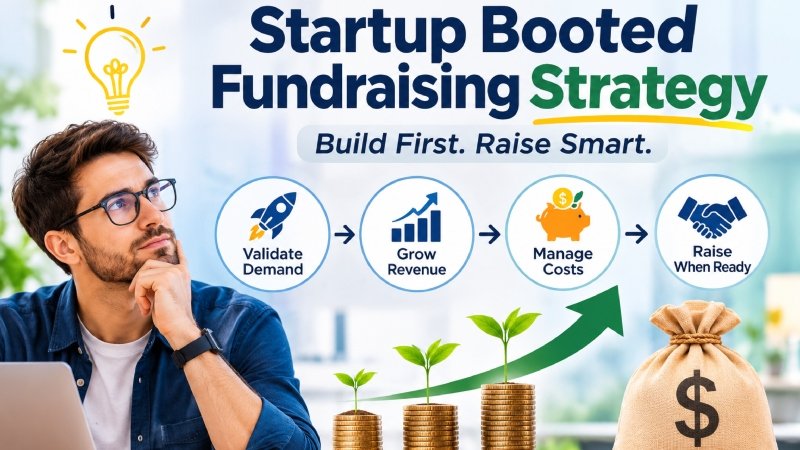
1. Validate the Business Idea
Before spending heavily, founders need evidence that customers actually want the product or service. Market research, customer interviews, early sign-ups, paid trials, and preorders can help test demand. Positive feedback is useful, but paying customers provide stronger evidence that a business solves a real problem.
2. Build a Minimum Viable Product
A minimum viable product (MVP) is a basic version of a product that allows a startup to test its main value with real users. Instead of investing heavily in unnecessary features, founders can launch a focused product, collect feedback, and improve it gradually. This reduces early costs and helps prevent spending money on features customers do not need.
3. Generate Revenue and Reinvest
When the business model allows it, early revenue can help finance operations and product improvements. For example, a small software company could use subscription income to pay for hosting, customer support, and development. Reinvesting revenue can reduce dependence on outside funding, although it may not be practical for businesses that require significant research, equipment, or regulatory approval before earning income.
4. Control Expenses and Monitor Runway
Financial discipline is essential when a startup operates with limited capital. Founders should understand their monthly expenses, cash balance, and available runway.
The basic runway formula is:
Runway = Available Cash ÷ Monthly Net Burn
Suppose a startup has $60,000 in available cash and spends $10,000 more each month than it earns. Its estimated runway is six months. Monitoring runway helps founders recognize financial problems early and make informed decisions about hiring, marketing, and fundraising.
5. Identify What Is Limiting Growth
Before seeking investment, founders should identify the actual business problem. A startup may need more customers, better product retention, improved distribution, additional employees, or greater production capacity. Funding can help address these problems, but raising money without understanding the obstacle can lead to unnecessary spending.
The strongest fundraising decisions connect a specific amount of capital to a measurable business objective.
Bootstrapping vs. Booted Fundraising vs. Traditional Fundraising
These approaches have different priorities. Understanding the differences helps founders choose a suitable funding direction.
| Approach | Main Funding Source | Primary Goal | Main Consideration |
|---|---|---|---|
| Bootstrapping | Personal funds and business revenue | Grow independently | Growth may be slower |
| Booted fundraising | Early resources and selective external capital | Build proof before raising | Requires careful funding decisions |
| Traditional fundraising | Angel investors or venture capital | Accelerate growth | May involve equity dilution and investor expectations |
A booted fundraising strategy combines financial discipline with the option to raise capital when the business is ready. It does not mean every startup must eventually accept investment.
Which Funding Options Can Founders Consider?
Bootstrapping is not the only alternative to traditional venture capital. Founders can consider several funding sources depending on their business model, financial position, and growth requirements.
Personal savings can help founders launch an early product, but using personal money creates financial risk. Customer revenue provides a more sustainable source when the business can generate sales early. Grants may support eligible businesses without requiring equity, although application requirements and availability vary.
Angel investors can provide capital and industry experience in exchange for ownership. Revenue-based financing allows eligible companies to receive funding in exchange for an agreed share of future revenue. Business loans provide another option, but repayments and interest can create pressure even when revenue is weak.
Venture capital may be appropriate for startups with significant growth opportunities and a business model that can support rapid expansion. However, founders should understand the ownership, governance, and expectations attached to any investment.
When Should a Startup Raise External Funding?
External funding becomes worth considering when the business has a clear reason to use it and a realistic plan for generating value from the investment.
A startup may be ready when it has demonstrated customer demand, developed a workable product, identified a repeatable sales process, or found an opportunity that requires more capital than its current resources can provide.
For example, a company with strong customer demand may need investment to expand production or enter a new market. In that situation, fundraising can help the business capture an opportunity that would otherwise be difficult to pursue.
However, raising money simply because competitors are doing so is not a strong reason. Founders should understand how much they need, what the money will accomplish, and how the business will measure progress.
Important Metrics Founders Should Track
Investors and founders use financial and operational metrics to understand whether a startup is making progress. The most useful measurements depend on the business model.
A subscription-based software company should pay attention to recurring revenue, customer retention, churn, customer acquisition cost, and gross margin. A marketplace should monitor transaction volume, repeat purchases, and the balance between buyers and sellers. A consumer business may focus on conversion rates, repeat customers, engagement, and acquisition costs.
Founders should also understand their cash flow and runway. Revenue growth alone does not guarantee financial stability if expenses are increasing faster than income.
Common Mistakes to Avoid
- One major mistake is confusing customer interest with actual demand. Compliments, website visits, and social media engagement do not necessarily prove that people will pay for a product.
- Another problem is cutting essential expenses simply to preserve cash. Reducing unnecessary spending is sensible, but underinvesting in product quality, customer support, or critical operations can damage the business.
- Founders can also make poor decisions by delaying fundraising for too long. If a business has a time-sensitive opportunity or requires substantial capital, refusing all external funding may limit its potential.
- Finally, accepting investment without understanding the terms can create long-term problems. Founders should carefully review valuation, equity dilution, investor rights, repayment obligations, and legal agreements before accepting capital.
Is a Booted Fundraising Strategy Right for Every Startup?
No. This approach can work well for businesses that can launch with relatively low initial costs and generate revenue early. Certain software companies, consulting businesses, and small digital businesses may be able to grow this way.
However, biotechnology, hardware, advanced manufacturing, and other capital-intensive industries often require substantial investment before they can generate meaningful revenue. Businesses operating in highly regulated markets may also face significant early expenses.
For these companies, external funding may be necessary from the beginning. The right strategy depends on the time, money, technology, and resources required to reach the market.
Frequently Asked Questions
What does startup booted fundraising strategy mean?
It generally describes a bootstrapping-first approach in which founders use personal resources and business revenue to establish their startup before considering selective external funding. “Booted fundraising” is not a standard financing category.
Is booted fundraising the same as bootstrapping?
Not exactly. Bootstrapping generally means growing a business using personal resources and internally generated revenue. A booted fundraising approach keeps that principle at the beginning while allowing founders to consider outside investment when needed.
Can a startup grow without venture capital?
Yes. Some businesses can grow through customer revenue, personal investment, grants, and reinvested profits. However, the feasibility depends on the industry, business model, and capital requirements.
When should founders start fundraising?
Founders should consider fundraising when they understand their market, can demonstrate demand, know how much capital they need, and have a clear plan for using the money. Some industries require funding much earlier than others.
What is the biggest risk of bootstrapping?
The biggest risk is running short of resources while trying to grow. Limited capital can delay product development, hiring, marketing, and expansion. Excessive caution can also cause founders to miss valuable opportunities.
Final Thoughts
A startup booted fundraising strategy is about making smarter financial decisions before and during business growth. By validating demand, controlling expenses, generating revenue where possible, and identifying genuine growth needs, founders can build a stronger foundation for future funding decisions.
The most important principle is balance. Avoid raising money without a clear purpose, but do not reject useful capital when it can solve a real business problem. A successful funding strategy should support sustainable growth while protecting the company’s long-term interests.
Visit My Site For More Information.